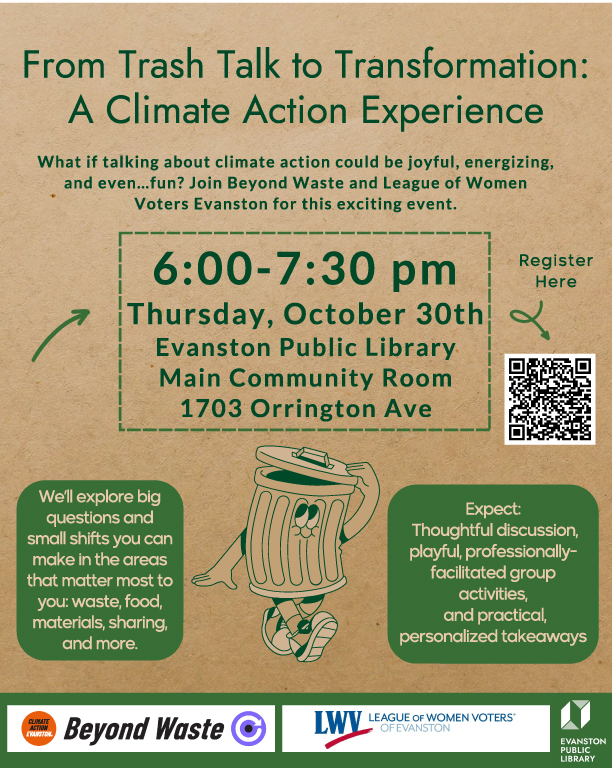
Join the League of Women Voters Evanston, Beyond Waste, and the Evanston Public Library for a deep dive into Waste and Circularity. Discover small shifts you can make that have a bigger impact than you may know! We’ll explore big issues in food, materials, waste, resource sharing and more with professional facilitators.
Expect thoughtful discussion, fun group activities, and lots of community building! Plan to leave with new ideas, practical, personalized takeaways, and new perspectives.
Date and Time
Thursday, October 30, 2025, 6:00 PM until 7:30 PM
Location
Evanston Public Library, Main Community Room 1703 Orrington Ave Evanston, IL 60201 USA
Registration Info
Registration is required
Register online through the Evanston Public Library.
Native plants need to be planted once and initially watered, weeded, and mulched. They are perennial and grow back every year without being planted again. Most of the plants native to this area are “drought tolerant”. Unlike your typical lawn, they don’t need regular mowing or wateringand will keep weeds out. Full-sized native plants need little to no mulch. Still, a yearly spring clean-up is recommended.
HELP ABSORB STORMWATER
Climate change brings heavier rainfalls. Our sewer system wasn’t designed for this increased amount of water per hour. With their very deep root systems, native plants absorb more water than turf grass or annuals during heavy rain events. Native plants help prevent sewer overflows and decrease water treatment costs saving our tax dollars.
Increase biodiversity and wildlife habitat
The insects in this area evolved in parallel with the native plants. Planting those plants will support a thriving insect community. This, in turn, will attract a thriving bird community, including cardinals, goldfinches, doves, and hummingbirds. To watch these birds in your yard, they don’t just need a bird feeder. Some birds eat seeds. Others eat berries. Some eat insects. Insects need plants. Planting a wide variety of plants provides food that attracts birds. Some insect-eating birds will help keep your mosquito population down for free!
Biodiversity means many different species living together in an ecosystem. It includes dozens of species of insects, birds, plants, and soil microbes. A healthy ecosystem supports many different types of plants and animals. It relies on those plants and animals to stay healthy.
Support healthy ecosystems
Healthy ecosystems are important because they supply many “ecosystem services” that we take for granted. They clean the air and give oxygen for us to breathe. They support the pollinators that allow us to eat everything from apples and cherries to tomatoes, mint, and squash. They mitigate flooding during heavy rain. Shady ecosystems reduce our cooling costs in the summer without increasing our heating costs in the winter. They clean the water so we don’t have to work as hard to remove pollutants from drinking water.
In 1997, New York City decided to spend $600 million to preserve a watershed north of the city. This decision was made because the microbes purify the water as it seeped through the soil. The alternative was to pay more than 10 times as much for a water treatment plant!
Sequester Carbon
Most of the things we do every day cause carbon dioxide (CO2) to be emitted. This gas stays in the air for up to a million years. It absorbs heat, which causes global warming. To prevent the world from warming up, it’s important that we reduce the amount of CO2 put into the air and pull existing CO2 out of the air!
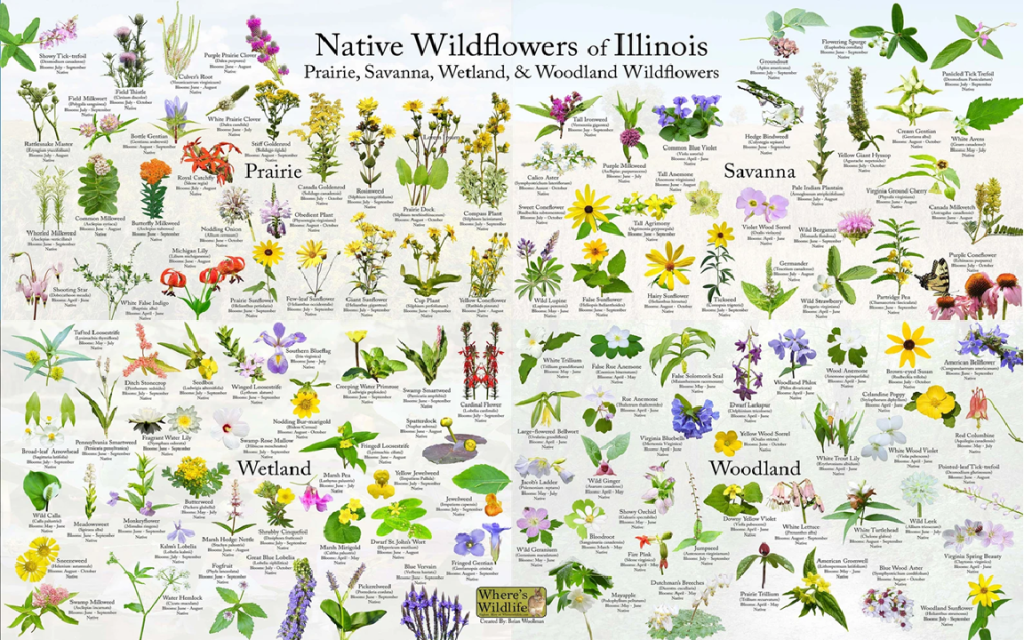
That’s where “carbon sequestration” comes in. It involves removing CO2 from the air and locks it away so CO2 can’t return. Trees and plants with deep roots like native Illinois plants pull a lot of CO2 out of the air. Can’t add trees to your yard? Opt to plant native grasses and flowers to help fight climate change!
Natural beauty all year
The typical Skokie yard is a lawn of Kentucky Blue Grass. Some houses are surrounded with a few yew bushes and some annual plants. It’s only pretty for about half of the year. The grass turns brown, the flowers are dead, and the bushes are “meh”.
A native garden provides “winter interest”. Winterberry holly and red twig dogwood are interesting to look at all year long and not just during the summer. They offer color. Native grasses and other native plants make your yard interesting and especially beautiful in the snow.
We loved the enthusiasm at this year’s Block Party Forum. The goal was to create fun and build lasting friendships and connections in your neighborhood. There is also a plan to make your block party greener. Our Zero Waste Block Party Quick Guide below can help you with that!
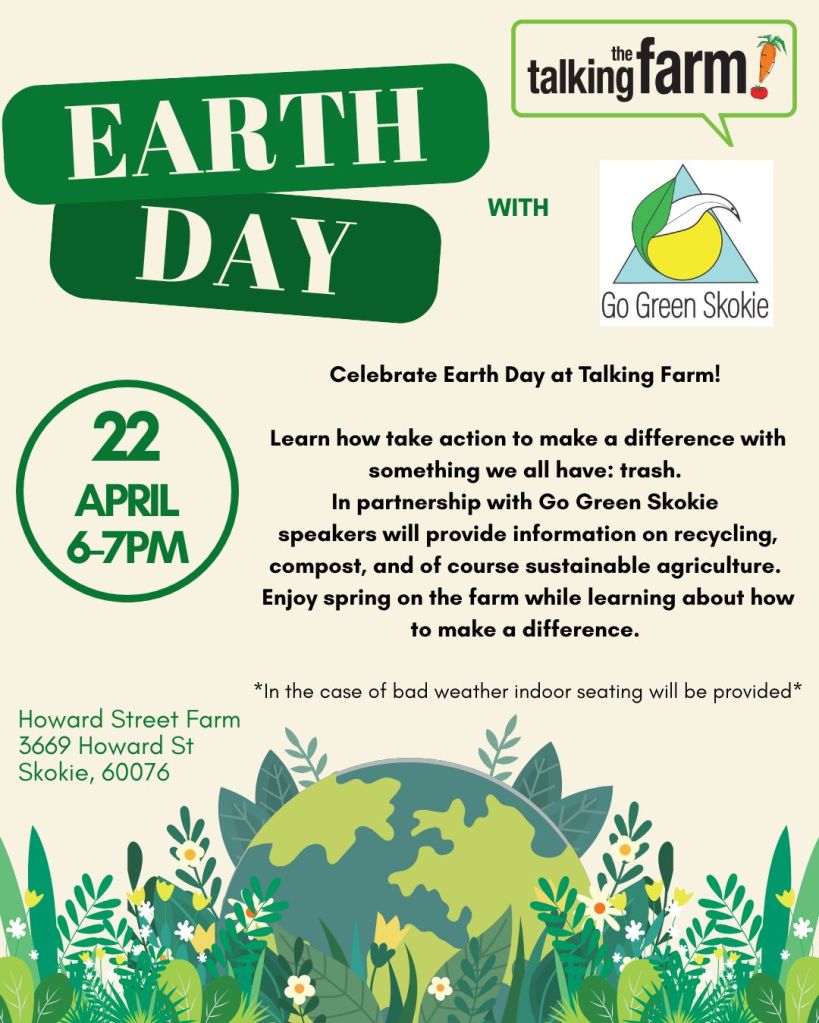
Come celebrate Earth Day at the Talking Farm! Join The Talking Farm and Go Green Skokie for tips on what can and can’t be recycled through the curbside program, the causes and solutions to the rat problem, and home composting.
Do you want to volunteer your time to fight climate change but don’t know where to start?
Do you want to learn how to reduce your carbon footprint at home?
Join the League of Women Voters, Climate Action Evanston, Beyond Waste, Natural Habitat Evanston, Go Green Skokie, Evanston Grows, Third Act, and Climate Action Coaches to learn who’s doing what in Evanston, and find out how you can make a difference!
Panelists: –Climate Action Evanston –Natural Habitat Evanston –Go Green Skokie –Beyond Waste –Third Act –Climate Action Coaches –Evanston Grows –Natural Area Stewards will be present for small groups and info sharing –And Collective Resource Composting will be present for small groups and info sharing
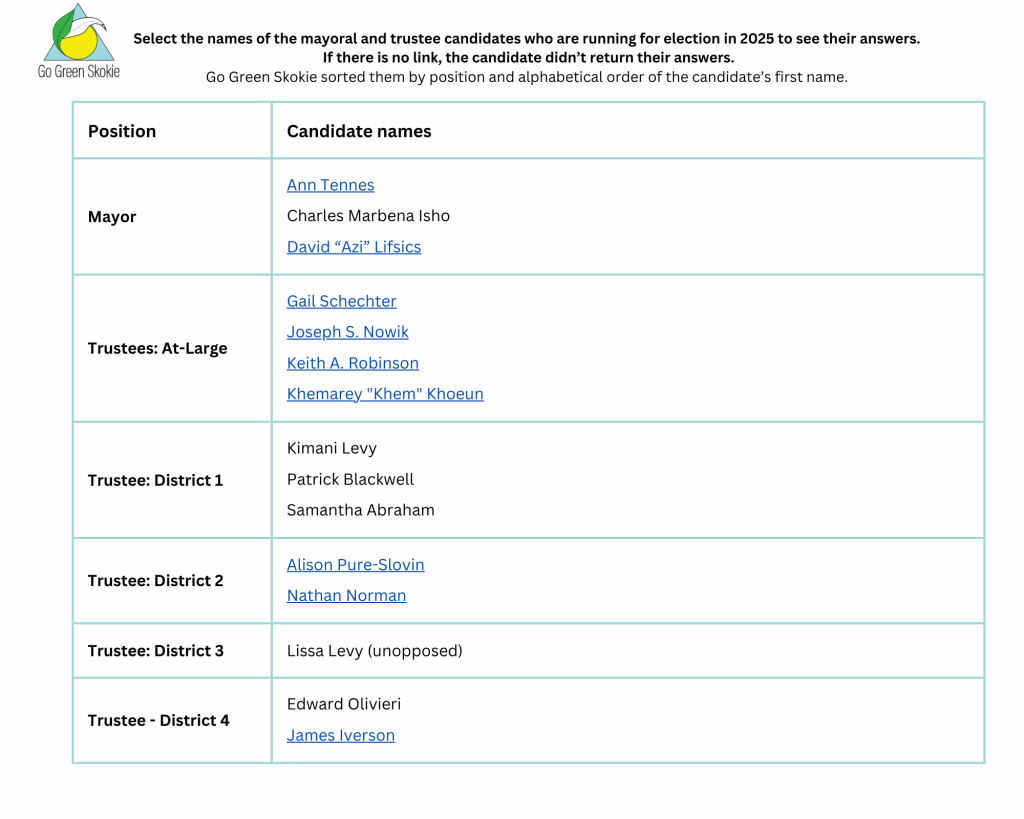
Go Green Skokie sent the following questions about climate change, Environmental Sustainability Plan, and their own priorities and vision of Skokie to all mayoral and trustee candidates who run for election in 2025.
Where does climate change mitigation fit into your list of priorities for the Village?
If you had a magic wand that could immediately implement 5 action items from the Environmental Sustainability Plan for free, which 5 would you choose and why?
What sustainability measures have you implemented in your household in the last 5 years?
How will you promote environmental education and awareness among residents, especially the younger generation, to foster a culture of sustainability?
Describe what you would like Skokie to look like in 2040 (15 years from now) in terms of the following categories:
Building arrangement and efficiency
Community
Transportation
Commerce
Walkability
Green spaces
Waste management
Food
What do you see as the Village Board’s role in realizing this vision of Skokie? How does that fit with the 2022 Environmental Sustainability Plan and its current implementation process?
Given that a certain amount of additional warming is inevitable now, what measures would you like to see to make Skokie more resilient to extreme weather events?
View their answers online in Canva by clicking on the picture below or download and print the PDF. Both copies, online in Canva and in PDF format, are to inform the public about the candidates’ answers, not to endorse the candidate. Six of the 15 candidates did not return their answers.
 gogreenskokie.org